
I Was Wrong About the Solo Operator Era (And I've Never Been Happier About It)
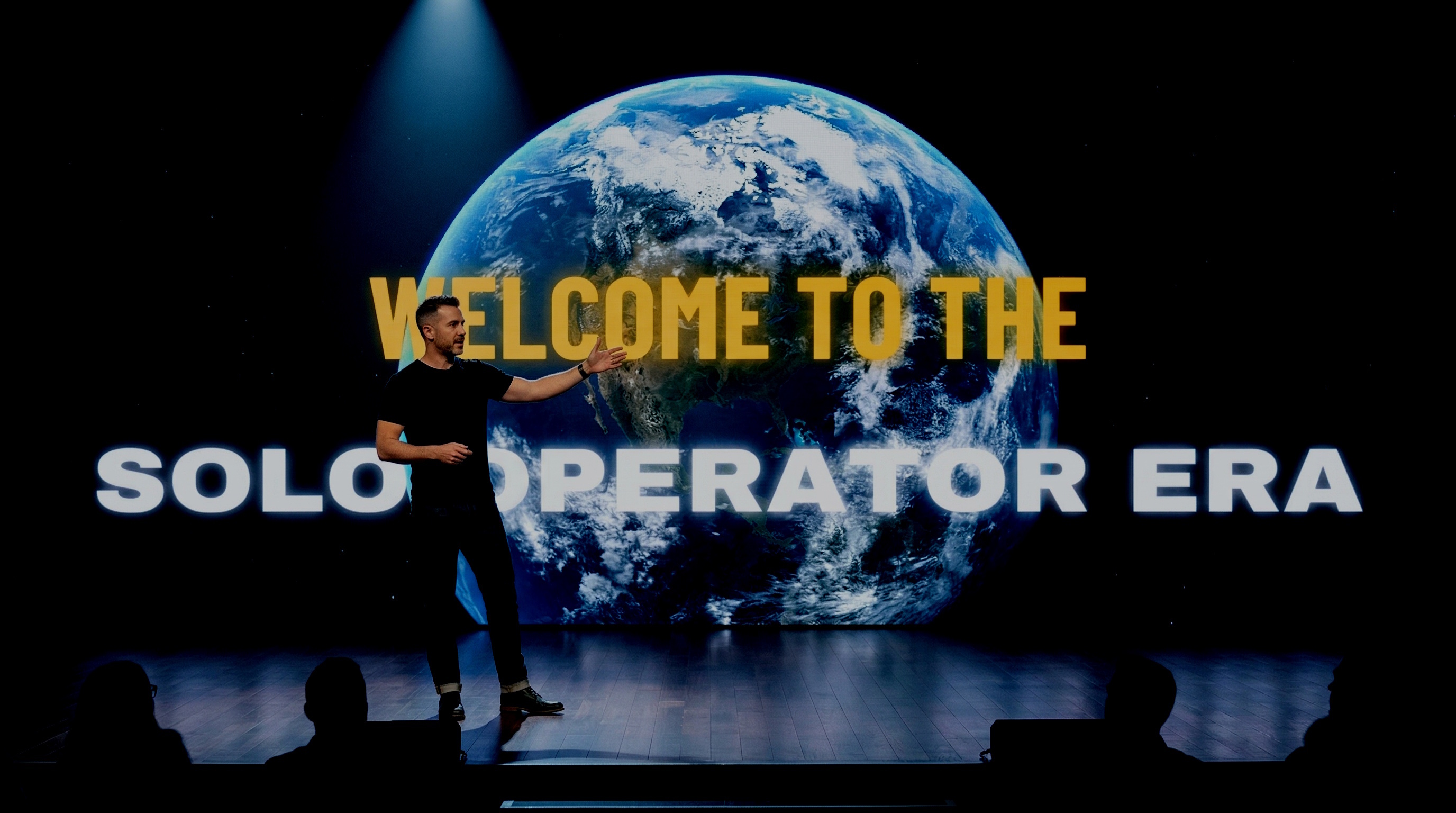
A few months ago, I told you that AI would enable one person to build a billion-dollar business. Turns out, it took two. Close enough.
Back in September, when we launched the ASM AI edition, I stood in front of a camera and made a prediction that a lot of people thought was crazy.
I said we were entering the "Solo Operator Era" - a time when AI tools had become so powerful that a single person, working from a laptop, could build and run a business that previously would have required dozens or even hundreds of employees.
I wasn't alone in saying it. I played clips of Sam Altman, the CEO of OpenAI, predicting that AI would soon make "a one-person billion-dollar company" possible. And Mark Cuban went even further, saying the world's first trillionaire "could be just one dude in a basement."
At the time, plenty of people thought we were all exaggerating.
Well, yesterday the New York Times published a story that proved us right. Almost.
Meet Matthew Gallagher - and His Brother
Matthew Gallagher is 41 years old. He lives in Los Angeles. He doesn't have a college degree. His previous company - a subscription watch business called Watch Gang - had 60 employees and never turned a profit.
In September 2024, Gallagher took $20,000 and a handful of AI tools and launched Medvi, a telehealth company that connects patients with doctors and pharmacies for GLP-1 weight-loss medications.
Two months. That's how long it took him to go from idea to live business.
In his first month, he had 300 customers. By the second month, 1,000 more. By the end of 2025 - his first full year - Medvi had generated $401 million in revenue with a 16.2% net profit margin. That's roughly $65 million in profit.
In 2026, the company is on track to do $1.8 billion in sales. That's billion with a B.
His total number of employees? One. His younger brother, Elliot, who he brought on in April 2025.
So technically, I was wrong. It didn't take one person. It took two. A guy and his brother. I'll own that miss.
How He Actually Did It
What makes this story so relevant to our community isn't just the jaw-dropping numbers - it's how he built it. Gallagher used more than a dozen AI tools to do the work that would normally require entire departments:
ChatGPT, Claude, and Grok wrote the code that powers his platform. Midjourney and Runway generated the images and videos for his website and ads. ElevenLabs powered AI voice technology for the business. He built custom AI agents to make his software systems talk to each other. And an AI chatbot handles customer service.
He didn't raise a dime of venture capital. He didn't need it.
For context, let's compare him to Hims & Hers - a publicly traded telehealth company in a similar space. Hims has 2,442 employees and generated $2.4 billion in revenue. Their net profit margin? Just 5.5%.
Gallagher is approaching the same revenue with two people and triple the profit margin.
When CareValidate's co-founder first started working with Gallagher, he asked him, "Do you have an army of people behind you somewhere?" Gallagher's answer: "Nope."
Sam Altman himself weighed in after the story broke, saying he "won a bet with tech CEOs" about when a one-person billion-dollar company would happen, and that he'd "like to meet the guy."
What This Means for You
Now, I want to be clear about something. I'm not telling you this story so you feel like you need to go build a billion-dollar company. That's not the point.
The point is this: the same AI tools that Matthew Gallagher used to build a $1.8 billion business are available to you right now, today, for the price of a monthly subscription.
ChatGPT. Claude. Midjourney. These aren't enterprise-only, Fortune 500 tools. They're the same tools we teach inside ASM AI. They're the same tools our members are using to research products, build brands, create listings, generate ad creatives, and handle customer service.
If AI can take one person from $20,000 to $1.8 billion in under two years, imagine what it can do for your ecommerce brand - even if your goal is $10,000 a month, $50,000 a month, or your first million-dollar year.
The gap between "big business" and "small business" is collapsing. The Solo Operator Era isn't a prediction anymore. It's a headline in the New York Times.
Was It Perfect? No. And That's the Point.
I also want to be real with you - Gallagher's story isn't all polished perfection. The article mentions that some of his early ads were rough. His AI chatbot occasionally hallucinated products and invented prices. His first website featured AI-generated photos that looked a little... off.
And you know what? It didn't matter. Because he shipped fast, learned fast, and iterated fast. The AI tools weren't perfect, but they were powerful enough to get him to market and let the results do the talking.
That's a lesson every one of us can take to heart. You don't need perfect. You need started. AI gives you the ability to move at a speed that simply wasn't possible before - and the businesses that move fastest right now are going to win.
The Gallagher Playbook
If you strip away the billion-dollar headline, Gallagher's playbook is actually remarkably simple:
- He found a massive market - GLP-1 weight-loss drugs are one of the biggest trends in healthcare
- He used existing infrastructure - he didn't build a pharmacy or hire doctors; he used platforms like CareValidate and OpenLoop Health to handle fulfillment
- He let AI handle everything else - coding, design, copywriting, customer service, and business analysis
- He moved fast - from idea to launch in 60 days
- He stayed lean - no investors, no overhead, no bloated team
Sound familiar? That's essentially the same playbook we teach for building an ecommerce brand - find a great market, leverage existing infrastructure (like Amazon), use AI tools to move fast, and stay lean.
The only difference is the scale. And honestly, scale is just a function of time and momentum when you have the right foundation.
The Solo Operator Era Is Here
Six months ago, "the Solo Operator Era" was a concept I was excited about. Today, it's a documented fact.
A guy who grew up living in motels and cars, who never finished college, who failed with a 60-person company - turned $20,000 and a set of AI tools into a business on pace to do $1.8 billion this year.
If that doesn't make you believe in what's possible right now, I don't know what will.
The tools are here. The opportunity is here. The only question is what you're going to do with them.
- Mike
Ready to start building your AI-powered ecommerce brand? Learn more about ASM AI and see how our members are using the same tools to build real businesses.